Kitesurfing for beginners: kite control, body drag and waterstart
Kite control, safety, body drag and your first start in the water. The goal: ride on your own, recover your board and come back in where you planned to.
Updated on
For information only. Not a substitute for lessons with a qualified instructor. Kitesurfing involves serious risks: learn and practice the safety systems with an instructor, follow your equipment manufacturer's instructions and always check conditions, equipment and local rules.
Kitesurfing demands strict safety management. A kite can generate very high forces and drag you in a matter of seconds, even out of the water. This guide helps you understand what is going on and prepare for your lessons: it does not replace them. Your first sessions must be done with a qualified instructor, at a school, at an authorized spot and with plenty of clear space downwind.
How the kite generates pull
The kite is a wing connected to you by the lines. The wind hitting it produces an aerodynamic force, and the pull you feel at the bar is the result of that force. It depends on:
- apparent wind: the wind the kite “feels”, that is the combination of the true wind and the kite's own movement;
- the kite's surface area;
- the wing's profile and shape;
- the angle of attack, which you adjust with the bar.
The force grows with the square of the wind speed relative to the kite. In simplified form:
q = ½ · ρ · V2
- q: dynamic pressure, in pascals;
- ρ: air density, about 1.2 kg/m³;
- V: apparent wind speed, in m/s.
Example: if a gust takes the wind from 15 to 20 knots, with everything else unchanged the dynamic pressure rises by about 78% (20² / 15² ≈ 1.78). Five extra knots don't sound like much, but the pull almost doubles. That is why gusts are a beginner's number one enemy.
The wind window
The wind window is the space where the kite can fly. Picture it as a quarter of a sphere in front of you, downwind: you are at the center, with the wind at your back.
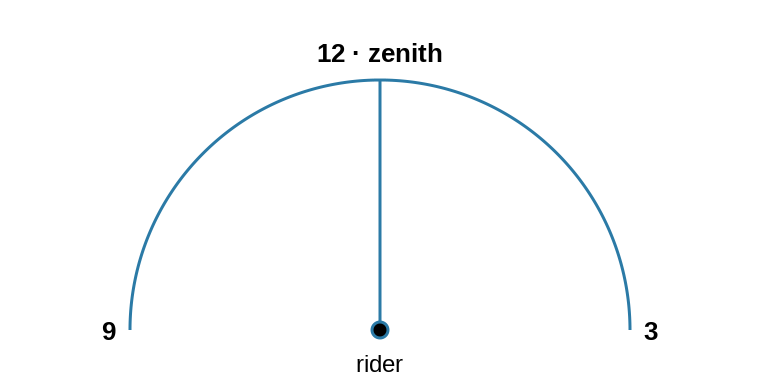
- Power zone: the central part, in front of you and low down. Here the kite cuts across the full wind and the pull is at its maximum.
- Edge of the window: the outer boundary, to your sides and above you. Here the pull is minimal and the kite tends to stall.
- Zenith: the highest point, above your head. It is called “12 o'clock”, thinking of the window as a clock face: 9 o'clock and 3 o'clock are the two extremes at water level.
The zenith is a resting position, but it is not always safe. With the kite at 12 o'clock a gust can lift you straight up, especially on land. That is why you must never hold the kite at 12 o'clock near obstacles, trees, buildings, roads or people. Also remember that the real window is three-dimensional and moves with you: if you change direction or speed, it changes too.
The gear
| Component | What it does |
|---|---|
| Kite | inflatable (LEI) or foil kite suitable for learning, sized for the conditions |
| Bar | controls the kite; includes the depower system and the quick release |
| Board | large, wide twin-tip, meaning symmetrical and the same in both directions, which is more forgiving |
| Harness | transfers the pull through your hips or waist instead of your arms |
| Safety leash | keeps you connected to the kite even after the quick release |
| Helmet and buoyancy aid | protect you from impacts and fatigue in the water |
Kite size doesn't depend on your weight alone. Average wind, gusts, kite type, board and level all count. Ask the school for advice: a kite that is too big is one of the most dangerous mistakes.
The safety systems
Words you need to know before you touch the water:
- Depower: pushing the bar away from you reduces the angle of attack and therefore the pull. It reduces power, but does not eliminate it.
- Chicken loop: the loop at the bottom of the bar that you hook into your harness hook.
- Quick release: the device that opens the chicken loop and makes the kite lose power in an emergency.
- Leash: the strap that keeps you connected to the kite, now depowered, after the quick release. There is also a final leash release, to separate yourself from the kite completely.
Every manufacturer has different systems that work in different ways. Read the instructions for your model and, above all, practice on land with a qualified instructor the depower, the quick release and the final leash release until they become automatic. Reading a guide is not enough: in an emergency, the only thing that counts is what you have already practiced with your own hands.
Wind conditions
To learn you need steady wind, water free of obstacles and, ideally, shallow water in the lesson area. Always check:
- direction: offshore wind, blowing from the land out to sea, is dangerous because it carries you away from the shore. Onshore wind, blowing straight at the shore, pushes you onto the beach. For learning, cross-shore or slightly onshore wind (side or side-onshore) is the right choice;
- gusts: the difference between average wind and gusts matters as much as the average wind, because the force grows with the square of the speed;
- space downwind: as a rough guide, at least 100 m of clear space downwind is common practice; the more space you have, the more margin you have for mistakes.
On Lake Garda and the other lakes of northern Italy you can check live wind and forecasts on madeinwind, a project by the same team. The final choice of kite and the decision to go out, though, are up to your instructor and you, on the spot.
Body drag
Body dragging means being pulled through the water without a board: you let the kite tow you while lying in the water. It helps you get used to the pull and, above all, to recover your board when you lose it.
- Downwind: kite moving in front of you, you let yourself be dragged with the wind.
- Across the wind: keep the kite on one side of the window and use your body like a keel, with one arm stretched out in front, to move sideways.
- Upwind: by switching the kite from side to side and angling your body, you gain a few meters upwind to get back to the board.
Move the kite progressively, never with sudden jerks.
With your instructor, leave the board in a visible spot, drift 20–30 meters downwind and body drag back to recover it, first with the kite on the right, then on the left.
The waterstart
The waterstart is starting from the water: you sit with the board on your feet and the kite lifts you up.
- Board on your feet, knees bent, body compact.
- Board pointing slightly downwind, in the direction you want to go.
- Bring the kite from the zenith toward the power zone with a controlled movement.
- Let the pull lift you, without pushing against the board.
- Only straighten your legs once you are already up and the board is gliding.
The classic mistake is trying to stand up using your leg strength instead of letting the kite carry you up.
Your first runs
Once you are up, look for a stable course: you control the pressure on the board's edge and the kite's pull at the same time. Keep the kite at mid-height, moving it calmly if the power drops.
Riding upwind, that is working your way up toward the wind, is a trade-off between speed and angle. If you head up too much, pointing too close to the wind, you lose speed and the board sinks. At first it's enough not to lose ground: ride on a beam reach and come back without drifting too far downwind.
Common mistakes and fixes
| Mistake | Likely cause | Fix |
|---|---|---|
| Sudden yank on the waterstart | kite moved too fast into the power zone | slower, wider movement, bar partly depowered |
| You stand up and fall forward | too much pull, legs straightened too early | less power, knees bent, weight on your back heel |
| The board sinks and you stop | heading up too much or kite not moving | bear away a little and move the kite to pick up speed again |
| Kite falls into the water | kite taken too far toward the edge of the window or slack lines | smaller movements, kite away from the edge |
| You lose ground downwind | too little load on the edge, kite too low | steady pressure on the edge, kite higher and stable |
Safety at beginner level
- Only learn with a school and at authorized spots.
- Never go out alone: there must always be someone who can see you and step in.
- No offshore wind and no conditions beyond your level.
- Kite low and away from obstacles when you are on land; always launch and land the kite with an assistant.
- Follow the shared right-of-way rules: the rider on starboard tack (right hand forward, wind coming from your right) has right of way; when two kiters cross, the one upwind raises the kite and the one downwind lowers it; the overtaking rider keeps clear. Find out about the spot's local rules, for example launch and return corridors.
Can you ride on your own, recover your board by body dragging, start on both tacks and do you know the safety procedures for your gear? Your instructor is the one who confirms you are independent. If you get the go-ahead, you are ready for the intermediate level guide.